Picture this: a patient comes in, has a great first experience, and leaves happy. Your front desk team smiles, the visit notes are clean, and everyone moves on. Three months later, that same patient books their follow-up appointment — at a practice down the road.
Not because your care was lacking. Not because they had a bad experience. They drifted. And you never gave them a reason to come back.
This is happening in your practice right now, and the frustrating part is that most providers never see it clearly. They assume patients who don’t return were unhappy, or found someone cheaper, or just didn’t need more care. But the data tells a different story: most patient loss isn’t about competition. It’s about silence.
When a patient walks out your door and doesn’t hear from you again, you’ve left the relationship on hold — and patients don’t wait forever.
The Silent Patient Leak: What’s Actually Draining Your Revenue
Here’s a reframe that changes everything: patients don’t leave practices. They drift.
Drift is quiet. There’s no dramatic breakup, no complaint, no final appointment where they say goodbye. They just stop booking. Life gets in the way. The pain eased up. They told themselves they’d call next week, and next week never came. And your practice never followed up to close that loop.
The revenue impact is real. A practice with 500 active patients that loses even 15% to drift over a year isn’t just losing patient visits — it’s losing the downstream referrals, the specialty service conversions, and the lifetime value of relationships that were never given a chance to deepen.
And here’s the harder truth: drift isn’t a loyalty problem. It’s an operational problem. Those patients didn’t leave because they stopped trusting you. They left because no system existed to keep them in orbit.
Three Places Your Practice Is Bleeding Revenue Right Now
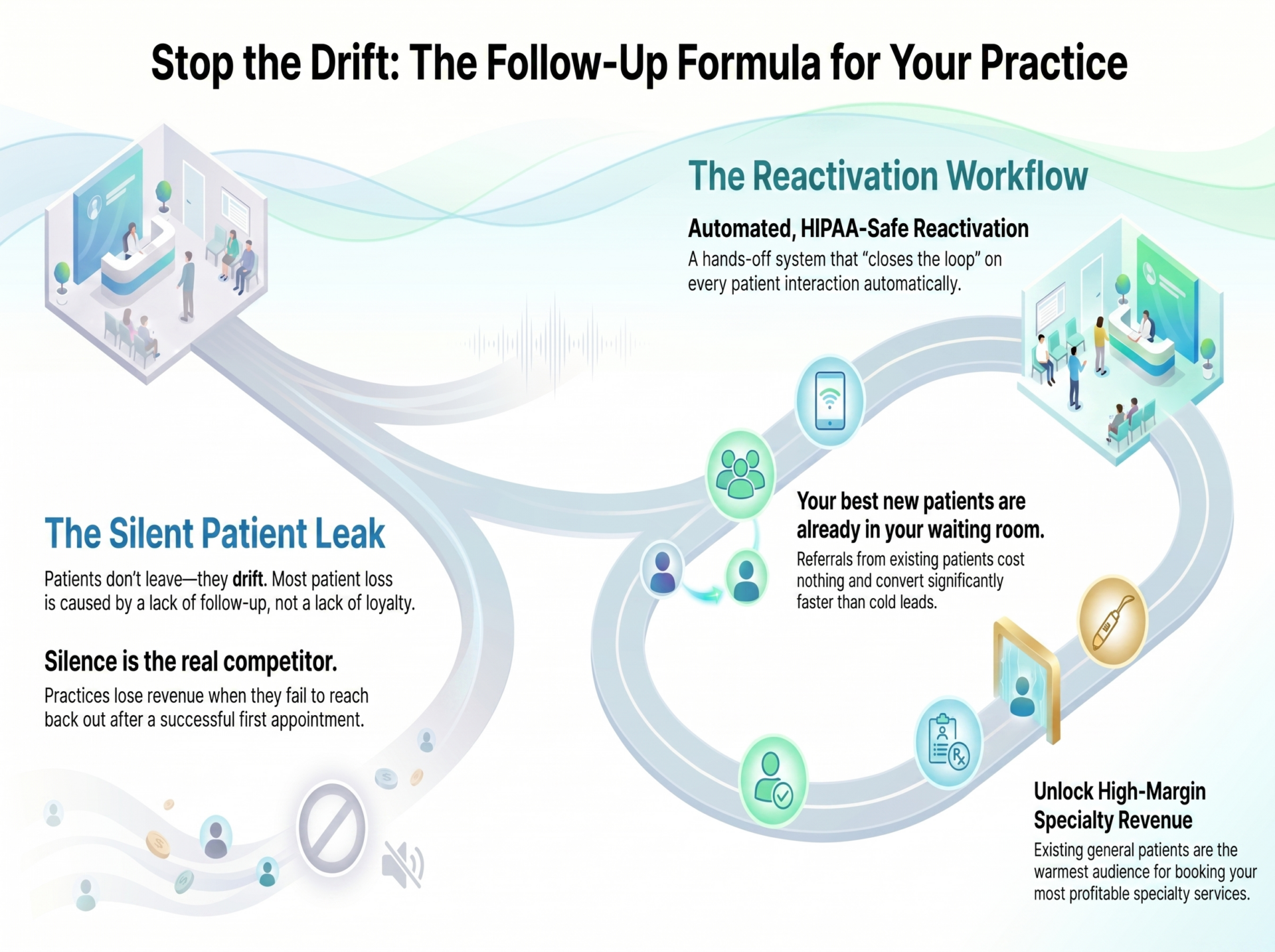
There are three distinct leak points that compound on each other. Understanding all three is the first step to plugging them.
Leak 1: The Baseline Drift
This is the most common and the most invisible. Patients complete their initial care plan or scheduled visit and simply don’t rebook. Your team assumes they’re fine. They assume they’ll call when they need you. Neither side picks up the phone — and a relationship that cost you real marketing dollars to build goes cold.
The diagnosis here isn’t disloyal patients. It’s the absence of a follow-up system. They simply forgot to book, and you forgot to ask. That’s an operational gap, not a patient care failure — and it’s one of the most straightforward gaps to close once you have the right framework in place.
Leak 2: The Unasked Referral
Your existing patients are your highest-converting lead source. Referrals from people who already trust you cost nothing to acquire and convert significantly faster than cold leads. But a patient referral system only works if the ask actually happens.
Most practices leave this entirely to chance — or to the memory of a busy front desk team. And when you rely on staff memory, the ask gets silenced. Not because your team doesn’t care, but because the ask has to compete with rescheduling, phone calls, insurance questions, and the ten other things that fill a clinic day. A structured, automated referral ask removes that bottleneck entirely.
Leak 3: The Specialty Service They Never Heard About
If your practice has added a specialty service line — regenerative treatments, aesthetics, decompression, weight loss, vein care, anything beyond the baseline visit — your existing general patient base is your warmest possible audience. These are people who already trust you, who have already overcome the activation energy of becoming your patient. They’re not cold leads. They’re pre-warmed prospects.
But here’s what’s happening: they’re leaving after their general appointment, and no system exists to educate and invite them into that specialty service after they walk out the door. Consistent specialty service conversion requires a mechanism that works after the visit — not just during it.
The Real Competitor: Silence
This is the reframe that changes how you think about patient retention. Your competition isn’t the practice two miles away. Your competition is silence — the absence of contact in the window after a patient visit when reconnection is most possible.
Most practices compete by trying to attract new patients. The practices that are actually growing are the ones who’ve built a system to protect and develop the patients they already have. New patient acquisition is important, but it’s expensive. Patient retention and reactivation is where the highest-ROI growth happens.
Patient loyalty isn’t an emotional problem. It’s an operational one. You don’t need friendlier staff, better bedside manner, or a more comfortable waiting room. You need the system that closes the loop on every patient interaction — automatically.
What a Follow-Up System Actually Looks Like
A real patient follow-up system has three functions running simultaneously.
First, it reactivates patients who’ve gone quiet — reaching back out to lapsed patients in your database with the right message at the right time, using automated sequences that don’t require your front desk to remember a single name.
Second, it systematically asks for referrals after positive patient interactions, so the ask happens every time without depending on staff bandwidth. Structured, automated, and HIPAA-safe.
Third, it introduces existing patients to specialty services through educational follow-up — a sequence that runs after the general visit and presents your high-margin services to the people most likely to book them.
None of this requires a large team. None of it requires your providers to become marketers. The whole point is that it runs without you managing it — that’s what makes it a system rather than a task.
The Operational Fix That Changes the Math
When you close the three leak points with a follow-up system, the math changes quickly. Recapturing even 10% of drifted patients in a practice with a few hundred active patients can add meaningful monthly revenue without a single new patient acquisition dollar spent. And when you add the referral channel and the specialty conversion layer, you’re building a compounding growth engine from the asset you already have — your patient database.
The practices that are growing predictably in this market aren’t the ones spending the most on ads. They’re the ones who’ve built systems that keep existing patients engaged, activated, and returning.
What’s Your Next Step?
If any part of this landed for you — if you recognized your practice in the baseline drift, the unasked referral, or the specialty service your patients don’t know about — the right move is to see exactly where your gaps are.
Join the Practice Accelerator Group community, where we walk through the Follow-Up Formula and every other step of the Practice Success System in practical detail. It’s free, it’s built for healthcare providers, and it’s the fastest way to get clear on what your practice actually needs next.
Or if you’re ready to talk about putting a system in place, book a strategy call with our team. We’ll walk through your current patient flow, find the leak points, and show you what a real follow-up system would look like for your specific practice.
The patients are out there. They haven’t forgotten you. They’re just waiting for someone to close the loop.